A book is never only a book.
It can be a door held open in the quiet. A voice reaching us from another room, another life, another century. It can give shape to a question we have carried without knowing its name—or let us glimpse, for the first time, a world beyond the one we have been shown.
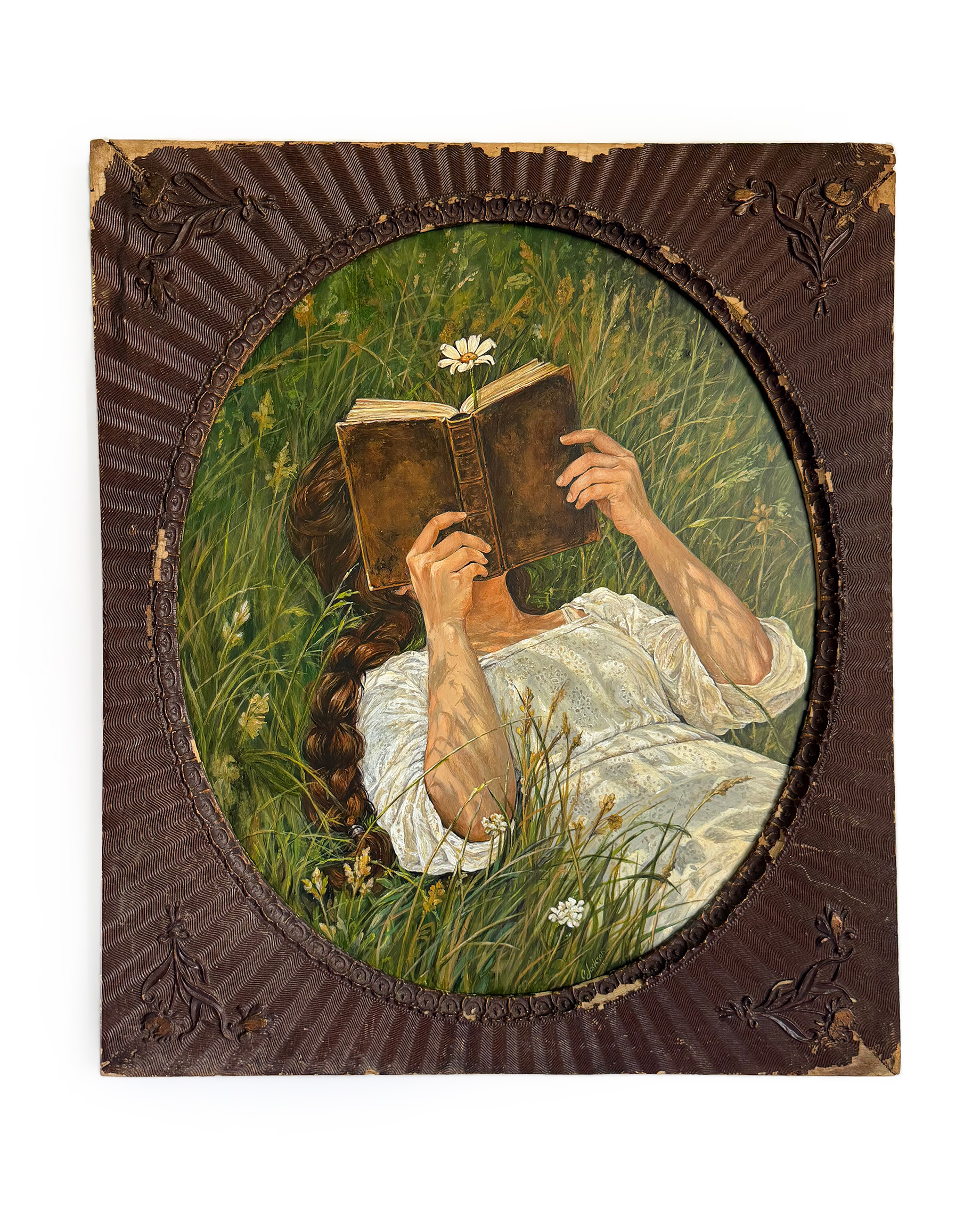
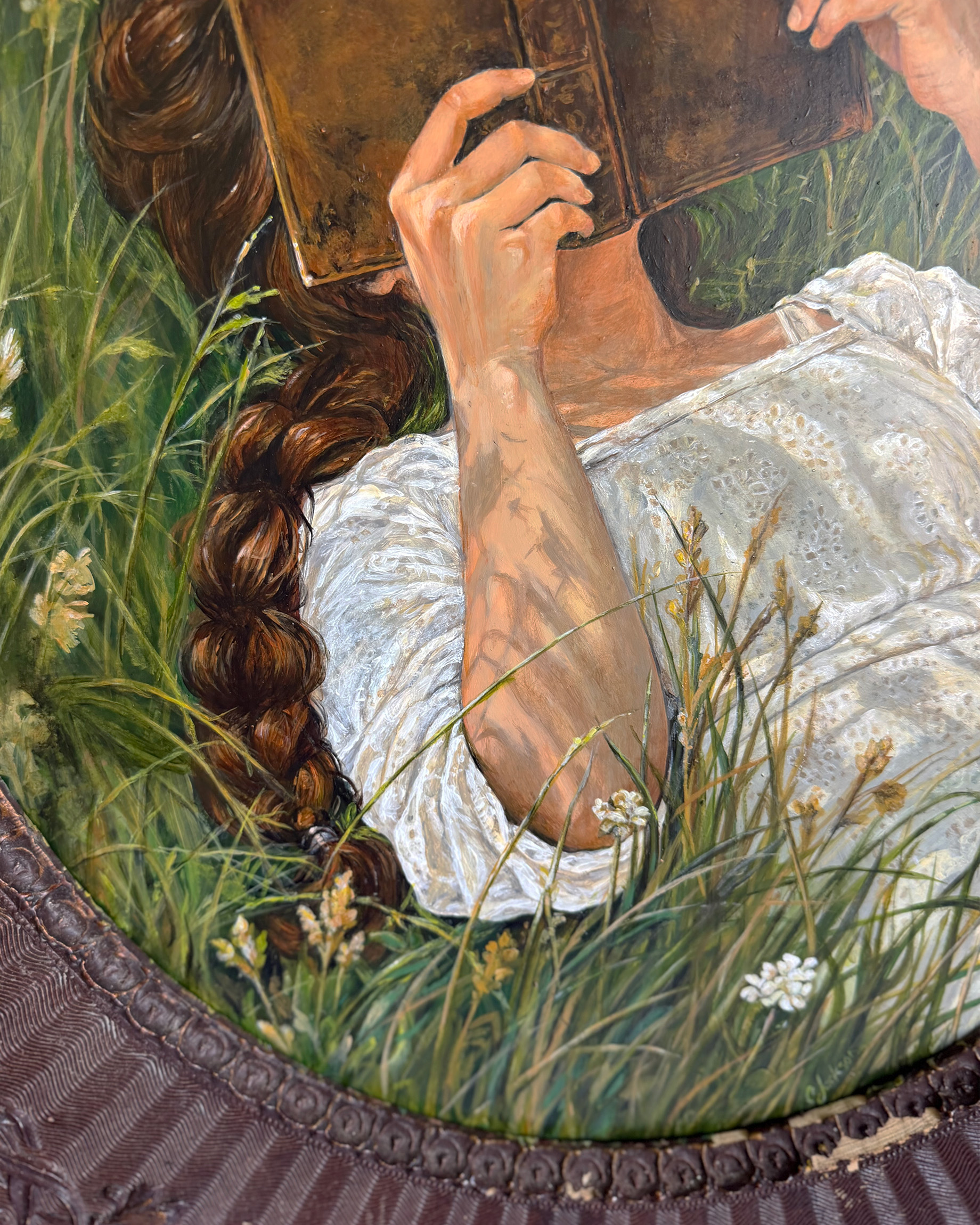
In The First Sanctuary, the book is a threshold: a peaceful place where another person’s words meet a young mind’s own wonder. Something passes between them—not an answer handed down, but a widening. A new way to see; a name for what had no name; the first glimmer that the world might hold more than she has been shown. The pages are hidden from us. What they may set in motion is not.
The painting grew from a place personal to me. Books were among my earliest refuges, but what they gave me was larger than escape. They gave me language, and through language, new ways to understand the world. They helped me recognize that what I knew was not all there was to know—that somewhere beyond the edges of my experience, other ways of living and thinking were waiting.
I read whatever I could find: science, biology, history, philosophy, poetry, fiction, nonfiction. I was homeschooled, and one year I had already read through my curriculum. Still hungry, I asked for more. My mother, a little exasperated but joking, suggested the encyclopedia. So I began with the A’s. I remember the pleasure of opening all those volumes and feeling that the world had not grown smaller because I had learned so much. It had grown larger.
And as much as I loved those books, I could hardly wait to get outdoors.
I would find some special place to read, but the meadow and its inhabitants had their own way of calling me away from the page. Nature was my living room, and one of my first teachers. I watched insects at work, listened for bird calls, studied the slow pageantry of clouds. I tried to discover where the mama raccoon had made her den for her new babies. I watched spiders build their webs, then watched the light find its way across a single strand. I studied the pattern inside a flower.
There was always more happening than I could take in at once. The world seemed to say: look closer. Stay awhile. Come back tomorrow.
The book and the meadow were never separate worlds to me. One opened through language and the lives of others; the other through attention—through the art of noticing what had been there all along. Looking back, I can see that this way of seeing was taking shape in me then: the instinct to linger, to look again, to discover the small intricacies that might otherwise pass unseen. Both taught me that wonder is a beginning. Both made me want to know more.
I still love following a question without knowing where it will lead. A story, a conversation, a new idea—or a small life moving through the grass—can alter the light by which we see what is already around us. Knowledge does not simply gather in the mind. Sometimes it loosens what has been fastened there. Sometimes it gives us a way to imagine a life we could not yet see.
For women, that widening has carried a particular history. Across generations, access to learning and independence was withheld from many women, or their desire for either was treated as unnecessary. Their lives were often measured by what they could provide for others, while their own questions, ambitions, and inner worlds were asked to wait.
I think of a woman in my family, only two generations before me, who wanted to start a business but could not get a loan on her own; she needed a co-signer. It is a reminder that the limits placed on women’s independence are not distant history. They remain within living memory.
The world has changed, and women have more room to study, earn, make, choose, and imagine a future of their own. That freedom matters. So does the knowledge and courage carried forward by those who came before us. Becoming is not something we do alone. We inherit questions as well as answers; stories as well as possibilities. We learn from one another, and sometimes a story shared at the right moment becomes a lantern in somebody else’s hand.
The daisy rests among the pages, still whole.
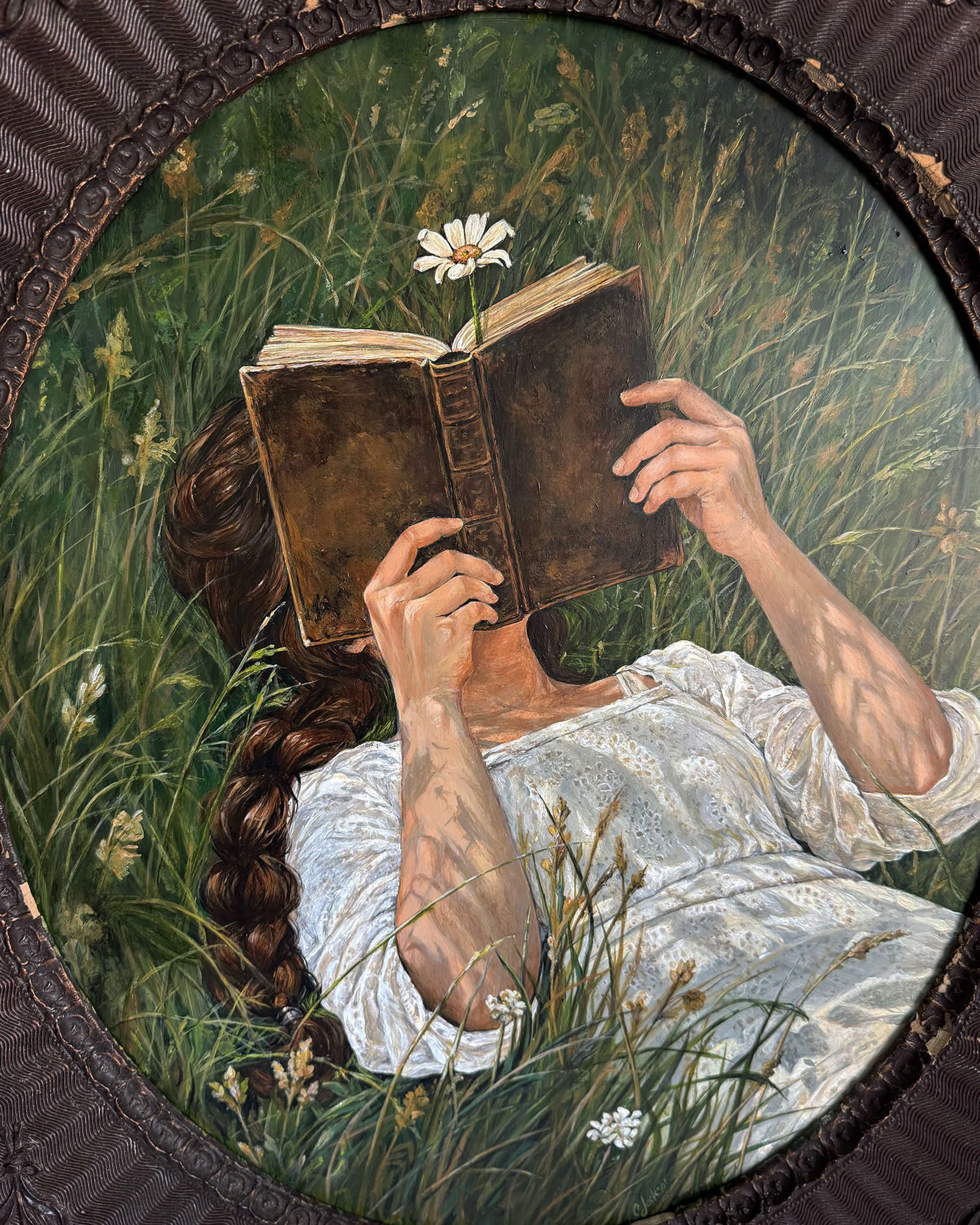
When I was young, I learned the old game: pluck a petal and say he loves me; pluck another and say he loves me not. I was a romantic, so I played—drawn by that small, persistent what if. But the daisy in this painting is not being taken apart in search of a verdict.
Perhaps, as we become, we grow less willing to place our wholeness in someone else’s keeping. We learn to recognize ourselves. We learn that love need not be earned by disappearing, or proved by how much of ourselves we can surrender. The daisy remains whole—not because she has no longing, but because longing does not make her incomplete.
As much depth as this piece embraces, it is also, quite simply, a beautiful moment—an invitation into quiet, into peace, into the simple pleasure of being at rest in the living world. That is not a smaller meaning. One of the things I treasure about art is that these visual stories can hold memories and questions, while remaining ready to hold whatever you find there.
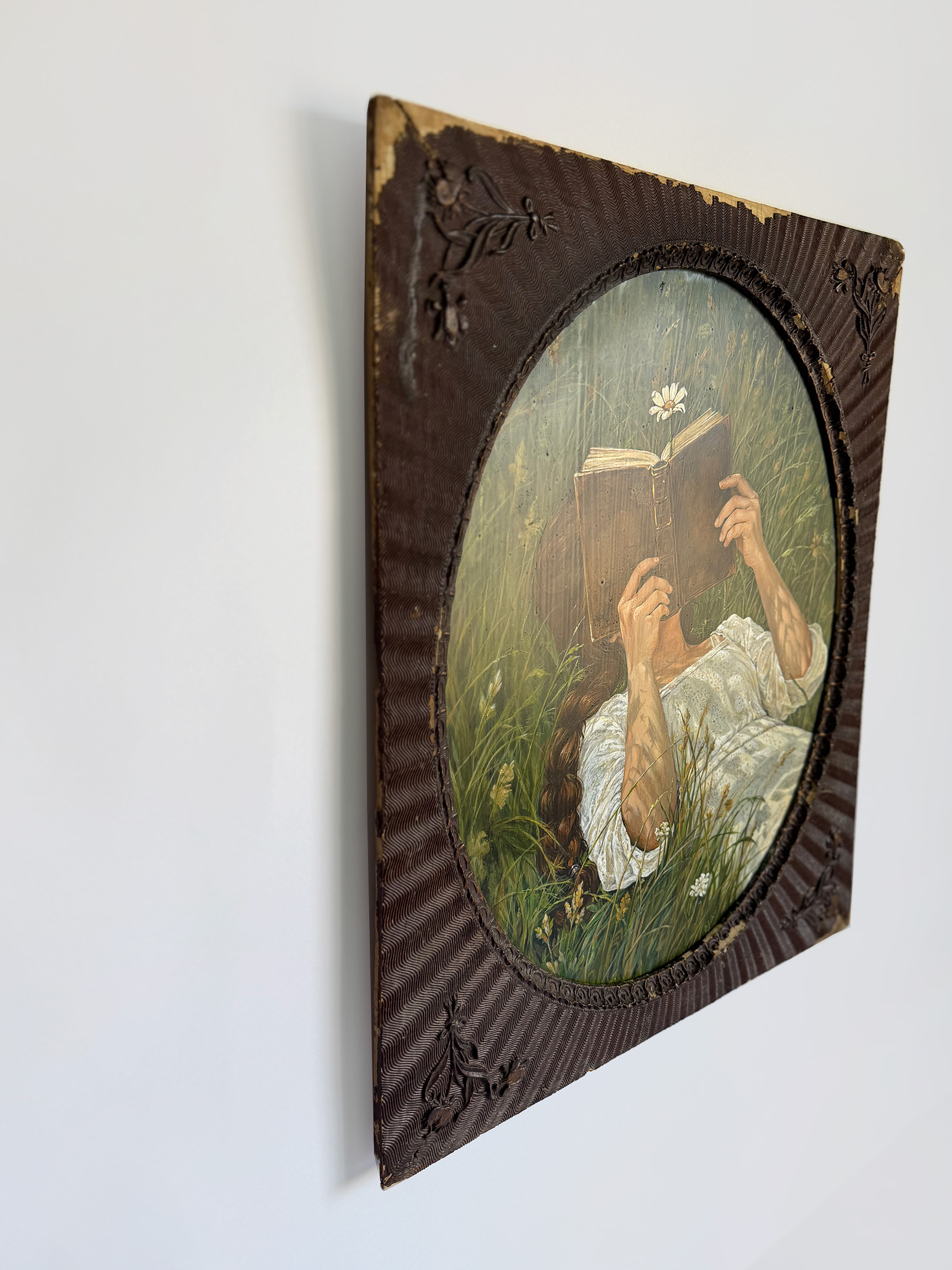
The girl rests, but she is not finished becoming. The meadow gathers around her; the book opens toward all she has yet to discover. Beyond its pages are the lives she may encounter, the knowledge she may seek, the questions she has not thought to ask. Within her is the growing capacity to meet them.
That is why The First Sanctuary stands at the beginning of Sanctuary of the Becoming. Many of the works turn toward creatures, nests, wings, roots, and the intricate making of the natural world. This one turns toward the inward life of a human being: the unseen becoming that begins when curiosity is allowed to grow, when we are given room to learn, when the world opens—and we are able to answer it.
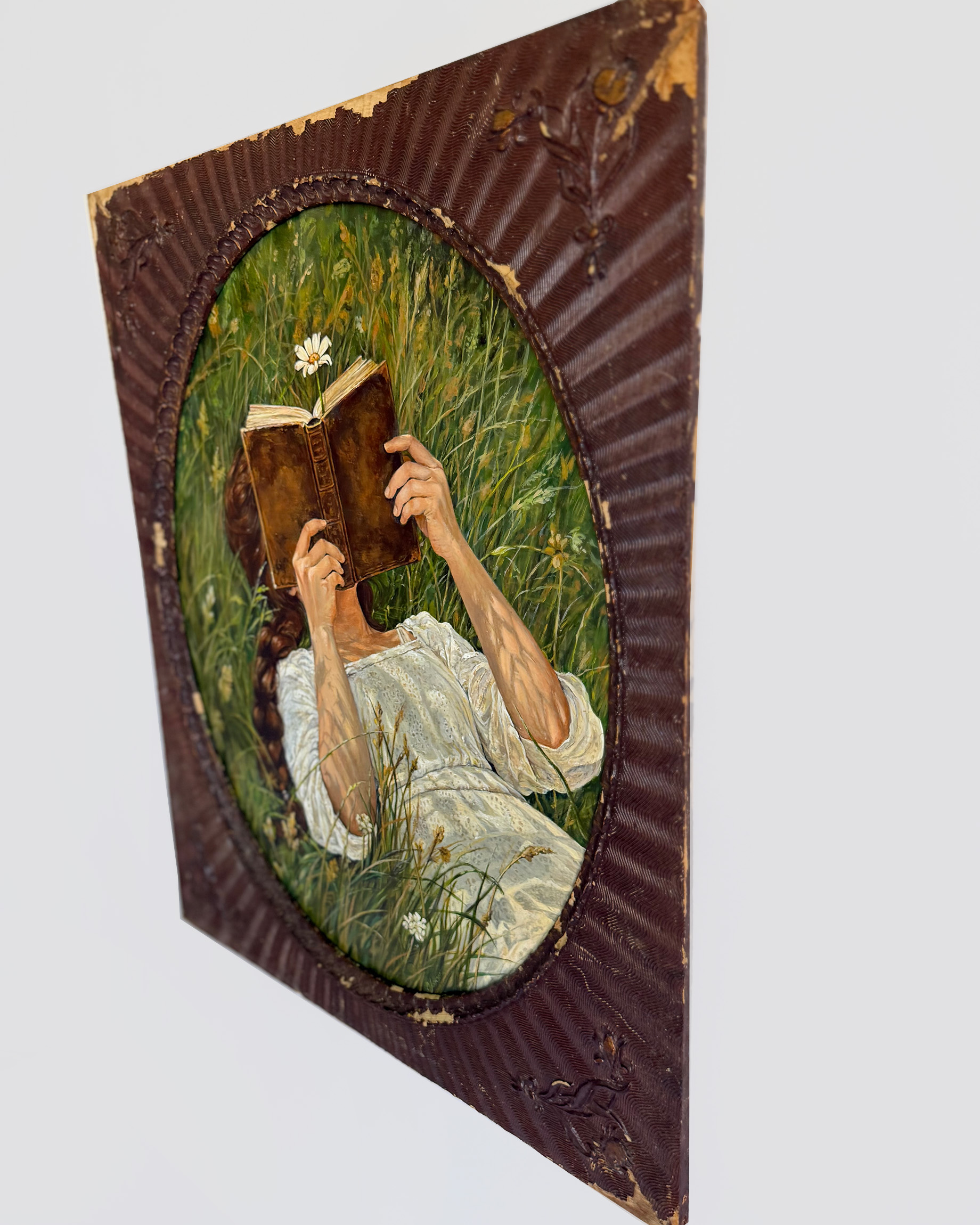
The sanctuary was never only a place to hide from the world. It was a place from which the world could be met. It was shaped in the pages we entered, the meadow we wandered, the things we learned to notice, and the wisdom we carried with us. It was made, slowly, as she became more fully herself.
Early in the exhibition, The First Sanctuary found a home with a collector in Switzerland. I’m grateful that this small meadow will travel so far.
At the heart of the exhibition, it holds a hope I return to again and again: that we may keep learning, keep looking closely, keep making room for one another’s becoming—and find, along the way, that we are more whole than we once knew. In that, I find a settling that envelops—a hope, and an active peace.
View Sanctuary of the BecomingAt Poetic Tiger GalleryReturn to Articles